
 Flexible Packaging Solutions | Dec 11, 2025
At BW Packaging, we’ve witnessed firsthand how sensitive agricultural goods can suffer losses without the right packaging and palletizing approach. Our mission is to help producers maintain the quality, value, and appearance of crops through every stage of the supply chain.
Below, we will explore the key challenges of agricultural product packaging, from preserving produce integrity during transport to managing fast-paced harvest cycles, and we’ll discuss modern palletizing solutions that keep delicate items safe. By the end, you’ll see how advanced bag-filling and palletizing systems can become an essential part of a profitable and efficient agricultural operation.
The Evolving Challenges of Agricultural Product Packaging
Delicate agricultural products, ranging from fruit and vegetables to grains and nuts, must handle a variety of external stressors. One major challenge is seasonal variation: harvest yields can skyrocket at certain times of the year, placing sudden strain on packaging lines. A packaging system that operates smoothly in low-volume months may struggle to keep pace when volume spikes, leading to bottlenecks and product mishandling. Modern solutions aim to adapt quickly to these seasonal fluctuations, ensuring that farms and facilities can scale production without sacrificing quality.
Another key issue is preserving product integrity throughout long-distance transport. Regardless of the commodity, be it apples, onions, potatoes, or grains, any damage along the way can reduce quality, increase shrink, and erode profits. Climate factors, including humidity shifts and temperature extremes, can sap freshness and invite mold or decay. Packaging and palletizing equipment must remain robust enough to form secure, uniform loads that stay stable on trucks, ships, or trains, even when road conditions are bumpy.
Meeting Seasonal Variations and Demand
Agricultural enterprises face unpredictable harvest cycles. In bumper-crop years, volumes may exceed the typical capacity of an older, partially automated system. Operators are forced to rely on manual pallet stacking risk injuries, slow throughput, and inconsistent loads.
On the flip side, investing in an oversized or inflexible palletizing system that sits idle for part of the year can be financially draining. As a result, many producers seek modular palletizing solutions that can be expanded or reduced based on actual harvest output.
Preserving Quality in Transport and Storage
Beyond harvest logistics, producers need to maintain product quality until the items reach wholesalers or consumers. For many types of produce, minor bruises or cracks can accelerate spoilage, while for grains, improper moisture levels can trigger mold growth or pest infestation.
A carefully optimized palletizing layout helps ensure gentle handling, minimal vibration, and stable stacking patterns that reduce the chance of goods shifting or toppling mid-transit. This stability is especially crucial for long hauls, where miles of road vibrations or ship movements could otherwise degrade product condition.
Understanding the Role of Palletizing in Agriculture
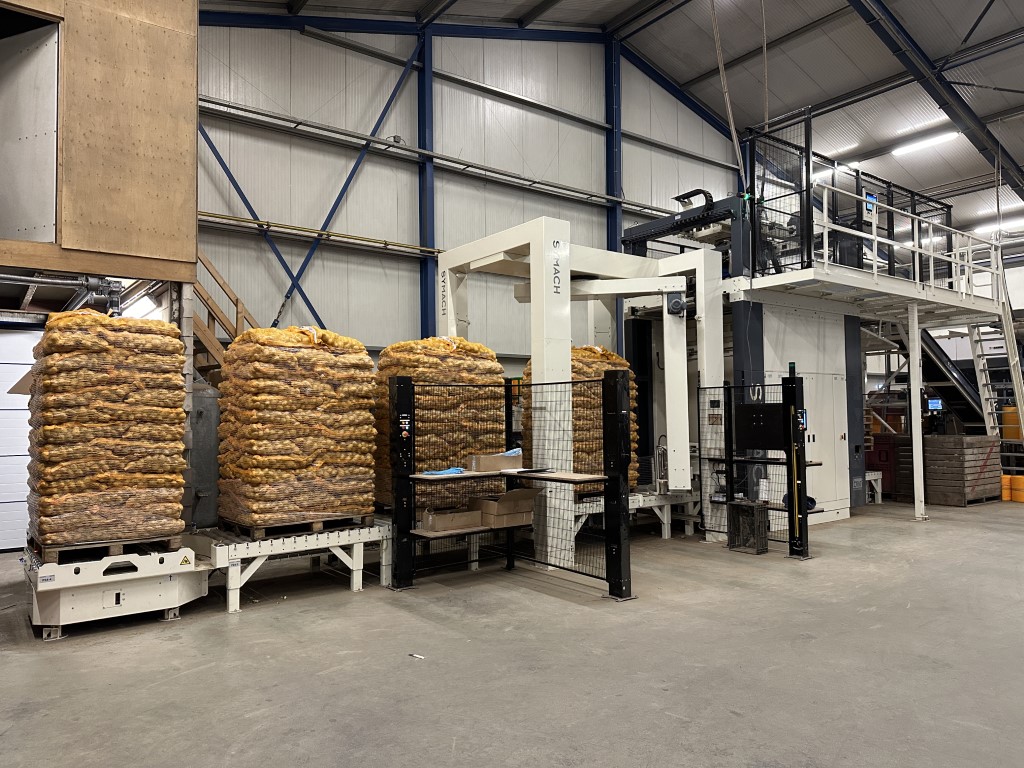
Palletizing is the process of stacking items, whether they’re in bags, crates, or boxes, onto pallets in neat layers. By mechanizing this task, farms and processing facilities can achieve consistent, uniform loads that withstand typical transportation rigors. Robust palletizing provides a protective cushion against shock, ensuring that delicate produce remains intact and unblemished. Modern palletizing lines often integrate with upstream bag-filling or crate-loading stations. This synergy means that once items are packaged, they move directly to a palletizing zone without manual intervention. Not only does this minimize human error (e.g., haphazard stacking), but it also significantly speeds up packing operations and lowers labor costs.Why Palletizing Matters for Agricultural Products
- Gentle Handling: Automated systems can lower bags or crates onto pallets rather than dropping them, reducing bruising or compression.
- Stable Stacking Patterns: Proper layering and interlocking help pallets remain stable even when subjected to sudden movements or abrupt stops in transit.
- Adjustable Configuration: Many palletizers allow different patterns or bag orientations so that facilities can pack multiple product types on the same line.
- Contamination Control: Automated stacking zones can isolate the product from outside contaminants or foreign materials.
- Scalability: Small producers can start with a basic robotic palletizer and add modules as volume grows.
Key Technologies in Modern Palletizing
Advancements in engineering and automation now let producers pick from a variety of palletizing technologies. Two common categories are robotic palletizers and conventional (layer-forming) palletizers. While both can handle delicate goods, each approach has distinct pros and cons.
Robotic vs. Conventional Palletizers
Robotic palletizers rely on multi-axis arms equipped with specialized end effectors (like grippers or suction cups). They can handle multiple bag shapes and sizes, adapt to new patterns quickly through software, and work within compact footprints. However, their throughput rates may be limited compared to layer-forming systems if extremely high speed is required.
Conventional layer-forming palletizers, on the other hand, use mechanisms like turning devices and layer squaring to build entire layers of product before placing them onto a pallet. These systems can achieve very high throughput and produce exceptionally stable loads. Yet, they can be less flexible if a facility needs to switch bag sizes or patterns frequently.
In-Line Vision Systems and Sensors
Modern palletizing equipment frequently includes vision systems to verify item orientation and alignment. Sensors can detect if a bag is misaligned on the conveyor, automatically pausing the process and alerting operators to prevent jam-ups. Advanced software then compensates for minor variations in bag positioning, ensuring neat, consistent layers.
Benefits of Automated Palletizing for Delicate Produce
When it comes to crops like tomatoes, peaches, and even bagged produce, mechanized stacking can provide remarkable advantages. While it’s tempting to assume only manual workers can “feel” the fragility of items, the latest robotic end effectors, combined with advanced controls, can emulate gentle handling and create stable, damage-free loads.
- Reduced Product Damage: Automated systems use low-impact gripping or controlled pushers that carefully position bags or crates.
- Enhanced Speed and Throughput: Instead of waiting for human operators to align every layer, the line can run continuously, even during peak harvest periods.
- Greater Consistency: Standardized stacking patterns mean less risk of collapsed pallets in transit.
- Labor Efficiency: Workers can focus on supervising and quality checks instead of repetitive lifting.
- Data Integration: Many palletizers log production metrics, allowing managers to track rates and identify bottlenecks over time.
Each of these benefits directly contributes to maintaining product integrity and an efficient overall operation.
Designing an Efficient Palletizing Layout
Even the best palletizing technology won’t perform optimally if the facility’s layout isn’t planned carefully. In some agricultural operations, space is at a premium, especially near post-harvest cleaning or sorting stations. The flow of product, from washing or sorting lines to bag filling and eventually to palletizing, must be smooth.
Managing Workflow and Floor Space
A layout that minimizes travel distance between stations is preferable. For instance, placing a bag-filling machine next to a conveyor that feeds directly into the palletizing cell keeps each step in close proximity. This reduces handling time and the chance of accidental drops or collisions. In addition, creating ample forklift lanes ensures pallets can be swiftly moved to cold storage or loading docks without crossing paths with ongoing production lines.
Adjusting for Seasonal Surges
Producers often see large spikes in output during harvest peaks. A modular palletizing cell can be expanded by adding another robotic arm or layer-forming module for these high-demand periods. Once the season ends, portions of the system can be idled or reconfigured. This flexibility helps maintain consistent speed without overinvesting in permanent capacity that might remain underutilized for part of the year.
Overcoming Common Palletizing Pitfalls
Switching to automated palletizing can solve many issues but also introduces new variables. One overlooked aspect is ensuring proper bag or crate filling so that each unit is symmetrical and stable. Irregular fill weights or shapes can hamper the robot or conventional palletizer, resulting in shaky layers.
Proper Bag/Crate Filling
Using high-precision weighers ensure each bag meets a target fill weight, which not only complies with labeling laws but also fosters consistent stacking. Overfilled bags can bulge, while underfilled ones may be too flimsy. In both scenarios, the risk of toppling increases. Employing bag vibrators or spreaders during the filling process can help distribute products evenly, especially for granular or irregularly shaped goods.
Material Compatibility
Agricultural products come in all shapes and densities; some are dusty, oily, or prone to static cling. Likewise, bag materials can range from woven polypropylene to biodegradable paper-based sacks. Each of these factors influences how well a palletizer’s gripper or layer pusher can handle the units. Thorough testing with actual products and packaging materials is key to verifying system compatibility before finalizing a palletizing solution.
Best Practices for Employee Training and Maintenance
Beyond hardware and software, employee expertise plays a pivotal role. Operators should understand how to perform basic troubleshooting, such as clearing minor jams or recalibrating the end effector. Written SOPs and consistent training sessions equip staff to resolve issues swiftly, minimizing costly downtime.
Scheduled maintenance is equally crucial. Replacing worn grippers, recalibrating sensors, and lubricating moving parts help maintain gentle, accurate stacking. For facilities that run around the clock during harvest season, a robust preventive maintenance plan can be the difference between on-time shipment and a backlog of produce waiting for repair crews.
Protect Your Agricultural Products with Bag Filling & Palletizing
We invite you to explore how Thiele, Symach, and integrated bag-filling technologies can bolster your agricultural packaging line. By combining gentle handling, robust construction, and modular expansion options, these systems offer a tailored approach to protecting delicate crops from the field to the destination.
When you partner with BW Packaging, you benefit from our extensive experience in optimizing production layouts and securing stable, damage-free loads. Contact us today to learn how we can design a solution that preserves freshness, reduces waste, and helps your operation thrive in a competitive market.
 %> "Flexible Packaging Solutions")